A two-seat Tesla drove up a curved ramp until it hung upside down, then fired jets of compressed air, flipped through the sky and landed on its wheels. Nine years after it was first promised, the new Roadster is finally real. Whether it is reasonable is another question.
Your first stop for car news: the quick version here, plus a button on every story that takes you straight to the original report.
Car of the Week
The car that does kickflips.
Tesla Roadster
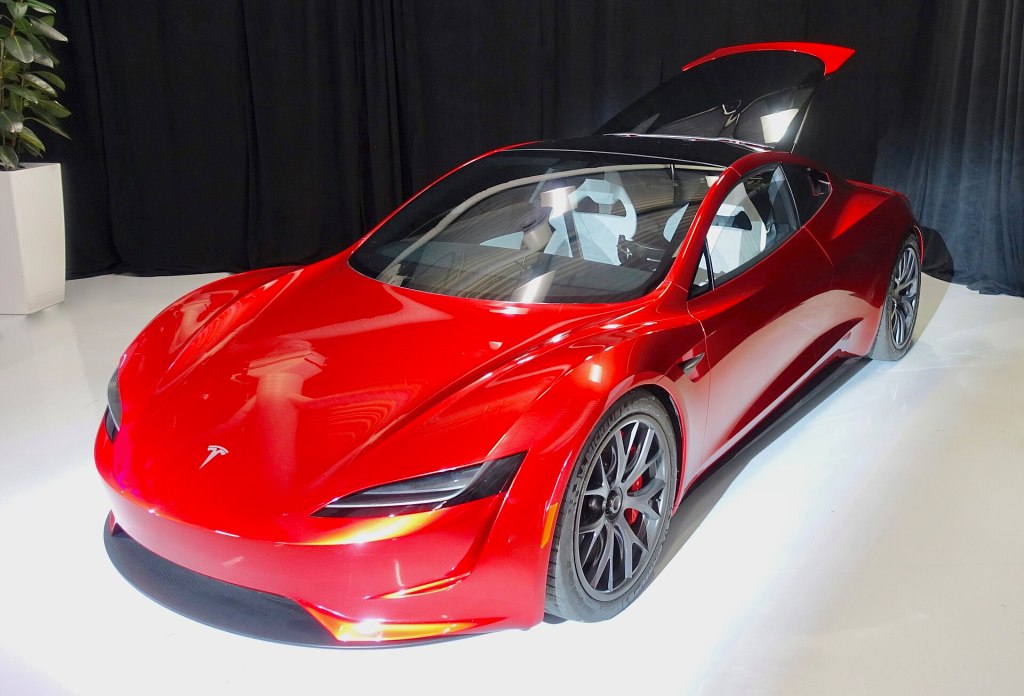
Tesla’s new Roadster: 0–60 in under a second, thrusters included
Tesla showed its next-generation Roadster on Thursday night at a SpaceX test site in McGregor, Texas. The show was pure theatre. In one stunt the car climbed a ramp, stuck to it with fan-powered suction until it was inverted, then used cold-gas thrusters built with SpaceX to launch off, flip and land. In another it leapt over a row of cars and a semi-truck.
Strip away the fireworks and the numbers are still wild. Tesla timed a live 0–60 mph run at about 0.81 seconds. It claims the top version can do it in 0.55 seconds, using thrusters, suction and a powertrain of more than one megawatt. Top speed is quoted at over 230 mph.
There are three versions. Performance has no air tank and is claimed to hit 60 in 1.6 seconds. Thrust adds a 200-litre tank of air stored at 10,000 psi and rear thrusters, for 0.85 seconds. Rocket is an invite-only single-seater with a “full flight system” and is not approved for public roads.
For context, a modern hypercar that hits 60 in 2 seconds feels violent. Halving that is like going from a fast elevator to being fired from a slingshot.
The suction system uses four fans of roughly 20 kW each. Tesla says they press the sub-1,700 kg car down with about 4,700 kg of force and allow more than 2 g in corners. A good sports car manages about 1 to 1.2 g. Electrek’s analysis calls that downforce figure surprisingly large and suspects some liberties were taken. It also notes that the fans are so loud that people hundreds of feet away wore earplugs.
Some promises have shrunk. In 2017 Tesla quoted 600 miles of range; now it says “over 300 miles” from a low-mounted pack of 4680 cells. Charging from 15 to 80% is claimed at about 10 minutes. The thrusters also need refilling: Tesla says that takes 6 to 7 hours today, with a 30-minute target.
Why it matters to you: almost nobody will buy one. Production is set for 2028, with no price announced. Tesla’s reservation page asks $50,000 to hold a Performance and $250,000 for a Thrust. The 2017 prototype carried a $200,000 base price and a 2020 delivery date that came and went. What may trickle down is the tech: suction and air thrust as tools for grip and braking, not just stunts.
The skeptics have fair points too. Thrust lasts only a few seconds at full power, and upward thrust lightens the tyres. Long exhaust plumes raise questions about debris near crowds and marshals. Electrek even thinks the Performance car, free of heavy tanks, may set the fastest lap times.
0.81 s
Live 0–60 mph run at the reveal
230+ mph
Claimed top speed
300+ mi
Claimed range, down from 600 in 2017
2028
Planned start of production
Quick take: (opinion) The flip was a magic trick. The Performance model, a sub-1,700 kg EV with silly acceleration and no air tanks, is the car that actually matters, if Tesla builds it on time.
Culture
A museum lets its hypercar go.
Bugatti Veyron
~A$2M
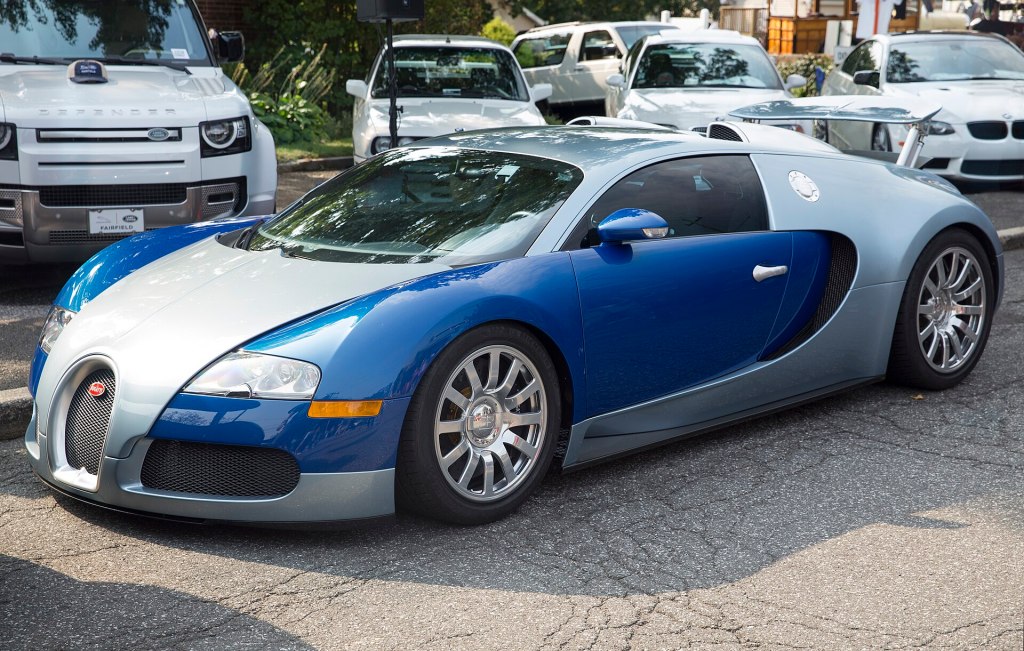
Australia’s National Motor Museum sells its Bugatti Veyron
The History Trust of South Australia has sold the 2008 Veyron 16.4 that drew crowds to the National Motor Museum in Birdwood for eight years. The car was bequeathed to the trust and cost A$2.7 million new. The sale price is reportedly about A$2 million, though the trust won’t confirm it or the buyer. InDaily’s source names Yasser Shahin, co-owner of The Bend Motorsport Park. The Veyron was the first production car past 400 km/h, with an 8.0-litre, quad-turbo W16. Its spot is now filled by a rare 1957 Mercedes-Benz 300 SL Gullwing.
EVs, Recalls & Robotaxis
Charge to 80%, and wait.
Recall
VW battery recall spreads beyond the US
Volkswagen says “several thousand” EVs built from 2023 to 2026 are being recalled because some high-voltage cells from SK Battery America fall short of quality standards. Affected models include the ID.3, ID.4, ID.7, ID. Buzz and Cupra Born, in the US, Germany and the UK. A US filing alone covers 22,524 ID.4s. Charging above 80% could lead to a battery fire, the root cause is still unknown, and there is no fix yet. Owners should cap charging at 80%. US letters are due November 27.
Waymo
Waymo heads to Toronto, its first Canadian city
Waymo will start mapping Toronto within days and wants public riders by 2028. It’s the company’s fourth announced market outside the US, after London, Tokyo and Singapore, with Magna as its manufacturing partner. One catch: Ontario’s self-driving pilot rules expire in October 2027 and nothing has replaced them yet. In the US, Waymo already gives more than 500,000 paid rides a week.
Kia PV5
Kia’s rental van drives itself to you, with a remote driver
In Pangyo, South Korea, Kia has started a car-sharing pilot where the PV5 electric van is delivered to your door by a remote driver working over 4G or 5G. You drive it yourself, park it wherever you like, and the remote driver takes it back to base. The trial runs until year-end, and Kia plans to expand it in 2027. Kia calls it a first, though a US startup ran a similar service in 2023.
Your turn
Would you rather have the 1.6-second Performance Roadster with no tanks, or pay extra for thrusters you’d hardly use? Tell us in the comments.
Tomorrow: Race Day Preview & Week Ahead, with F1 heading to Austin next weekend.
Sources
- Electrek: A technical look at Tesla’s new Roadster
- Fox Business: Tesla’s new Roadster takes flight
- InDaily: History Trust sells rare sports car
- Electrek: Volkswagen recalls thousands of EVs
- Electrek: Waymo picks Toronto
- Electrek: Kia’s remote-driving PV5 car sharing
Photo credits: Tesla Roadster prototype and Bugatti Veyron 16.4 (by Mr.choppers) via Wikimedia Commons, used under their free licences.


.jpg)
.jpg)
Leave a Reply